
Authentically Authoring in the Age of AI Slop
Would you like to know the first question I usually get when I tell someone that I’m an author? Really? Okay…
“Do you use AI?”
A few short years ago, that question would never have crossed anyone’s mind. It would be, “What do you write?” “Where can I find your books?” “How do you pay your bills?” (Um, I have a partner who loves me more than life itself, and he’s generously helped me save up for the massive costs of self-publishing, cheering me on all the way… duh.)
Now, the answer is incredibly subjective, and the reason for the question usually hinges upon what the person asking imagines ‘use of AI’ means. For some professions, AI tools are rapidly being implemented, costs cut, and processes streamlined. For other professions, AI poking its frigid fingers into everyone’s pies is frustrating at best, career ending at worst. For creatives, its presence can mean downright theft.
What people don’t usually include in their initial question is the type of Artificial Intelligence they mean—or even understand—and how it is used in an author’s workflow (if at all).
AI overviews, searches, and ‘optimizations’ are rapidly becoming the norm, with little to no consultation of the offending platform’s intentions to their users; we are not given the choice to use AI or to opt out, it simply exists. I’ve noticed that the people screaming the loudest in opposition to any [yes ANY] type of AI are shouting their opinions on social media, most of which have AI integrated into the apps themselves.
What we need to understand is that ‘use of AI’ does not equate to ‘use of generative AI’. The most blatant offenders of the latter are AI ‘artists’ claiming to have created a digital image through skillful direction of prompts—they ignore the fact that the work of actual artists has been stolen and is being used without their consent, and without compensation. More and more lawsuits are being filed, and generative AI tools have been exposed as having scraped images on the internet/social media to train these massive models, along with video, original content, and yes, books, including pirated libraries, to churn out quick and dirty AI slop.
Let us be absolutely clear: The AI models being trained on art, content, and literature that they have not legally acquired the rights to IS THEFT, plain and simple. ***And I’m (purposefully) NOT getting into the argument that ‘use of AI’ has a negative impact on the environment—that subject is too nuanced for this blog post, and I know I’m not fully informed of the circumstances behind every single server complex and local watershed conditions, impact on the established population, electricity bills, etc.***
Do I think that means that all AI usage is wrong? Again, specify what you mean by ‘use of AI’.
I’ll give you an example: My husband works for a bank. Cybersecurity is the bank’s top priority. As a customer of that bank, I’d imagine that would be your top priority as well. Now think of all the ways a thief could use AI built programs, processes, or viruses to steal your hard-earned money—money you NEED to pay your bills, feed your children, donate towards worthy causes, or even support an Indie Author (wink, wink 😉)
I’ll give you another example: One of the best-selling video game franchises in the last decade has had their original IP copied by another developer who, after requesting permission from the IP’s owner to release their AI rip-off and hearing ‘NO’, continued to develop it anyways. Another AI model was able to generate almost word-for-word a significant percentage of a massively successful book, one that is ubiquitous to modern pop culture. The flimsy argument made by the owners of the AI was that this was ‘fringe behavior’ and that their researchers were actively working to address it.
My question to you is this: Would you prefer that AI not be used by the bank’s cybersecurity teams and allow the scammers, thieves, and unscrupulous individuals easy access to your money? What about the copyrighted IPs and novels that are clearly being stolen to train generative AI models?
The impact is that the big corporations get a slap on the wrist and pay a fine, but they still reap a windfall from all of the stolen material, while the smaller artists/authors/musicians hyperventilate if anyone even speaks the two letters “A I” in their direction. Not only can they lose their creative work to these leeches, they’ll be blacklisted and boycotted if they are suspected of AI usage, whether that’s true or not. In every scenario, the little guy is getting screwed over while the ones who need no further enrichment gorge themselves on the crumbs after they’ve devoured the whole cake.
The reality of the situation is that, no matter where you stand on the issue, AI exists, and it isn’t going anywhere anytime soon. Balance, while it can be difficult to find, is key. Is the artist, musician, or author with 2,000 followers on Instagram the bad guy? Do they deserve relentless bullying by others whose opinions dictate what they feel is right or wrong, or to lose their living to these soulless imitations of their art?
My personal opinion is that some authors may choose to use programs or platforms that have AI features built into them, and they can utilize them or avoid them as much as they like, so long as the AI isn’t ‘creating’ anything for them (and I use that word loosely—computers do not ‘create’ anything, they copy, and they’re usually poor copies at best).
All that being said, I value human creativity above all else. I pay my designer/illustrator for good quality, genre appropriate, and frankly kick-ass book covers for my novels, ALL of which are written by ME. I write for the joy of writing, to process emotions, to discover more about myself, and to understand the world around me. Why would I outsource that creative process to a computer? For myself, and for many other authors out there, we are sharing a part of ourselves, hoping to connect with readers that are looking for adventure, emotion, validation, and healing.
I don’t care how much training a computer gets, it lacks the thing that makes stories resonate throughout generations:
the human soul
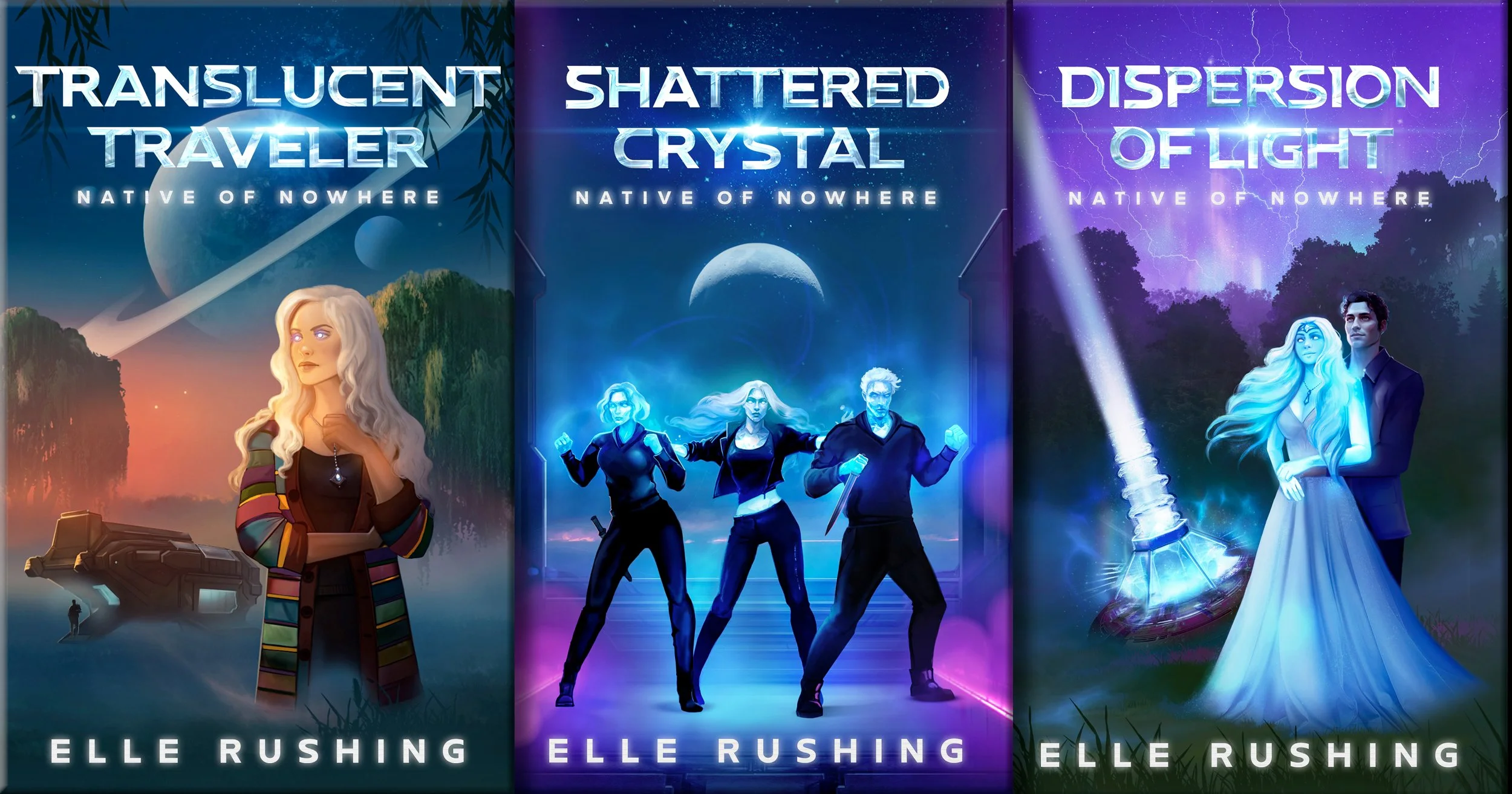
Elle Rushing’s debut trilogy, Native of Nowhere
100% HUMAN MADE 🚫 Gen AI (crazy, I know, even the kick-ass cover art from MiblArt!) Click the image to start reading sample chapters for FREE!
